Selecting the correct corrugated box size is essential for safe, economical, and professional courier shipping. A box that is too small may damage or compress the product, while an oversized box requires extra packing material and can increase the shipment’s volumetric weight.
Finding the perfect balance protects your bottom line and your customer satisfaction. Here is a step-by-step guide on how to select the perfect corrugated box size for courier shipping.
This guide explains how to measure your product, calculate the required clearance, and choose the right corrugated box for courier delivery.
1. Measure Your Product Accurately (The 3 Dimensions)
Before looking at box catalogs, you need the exact dimensions of your item. Use a firm ruler or measuring tape to find:
- Length (L): The longest side of the product.
- Width (W): The shorter side of the product.
- Height (H): The vertical dimension from top to bottom.
Shipping Tip: Always measure the product at its widest points. If you are shipping an irregular item (like a mug with a handle), include the handle in your measurements. If you are shipping multiple items together, bundle them together tightly and measure the entire cluster as one single object.
2. Account for Interior Cushioning (The +0.5 Inch Rule)
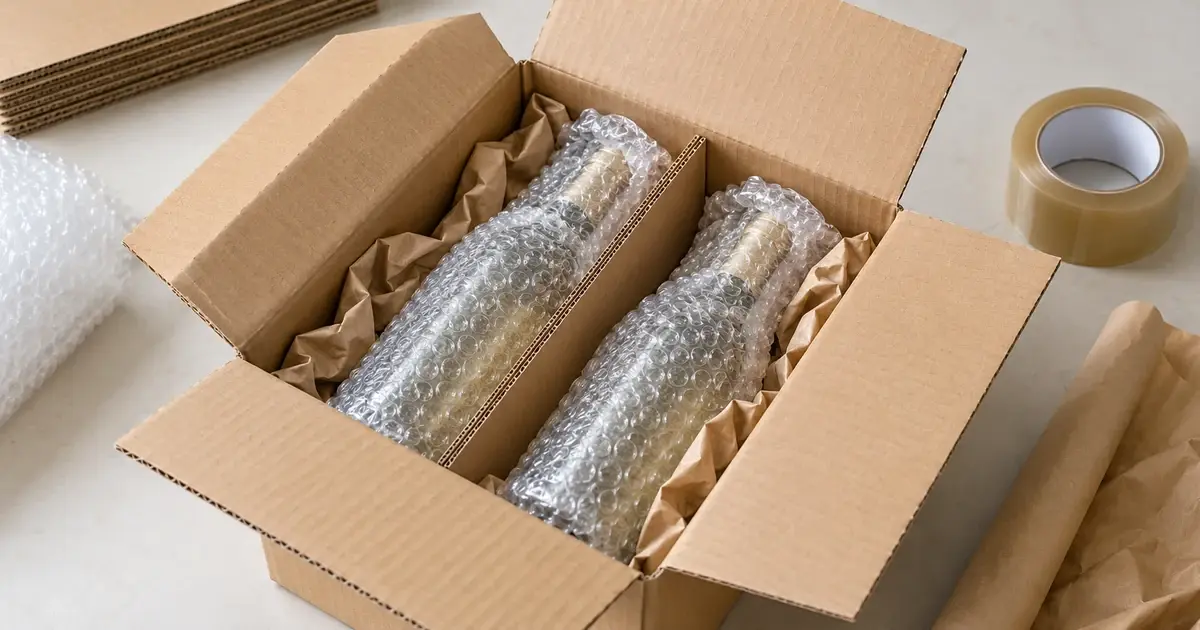
Never choose a box that matches your product’s dimensions exactly. You must leave room for protective void-fill materials like bubble wrap, packing paper, foam, or air pillows.
- For Sturdy Items: Add at least 0.5 inches to the length, width, and height of your product dimensions.
- For Fragile Items: Add 1 to 2 inches to all sides to ensure there is a thick buffer zone of bubble wrap protecting the item from external drops and impacts.
3. Understand Box Dimensions: Internal vs. External
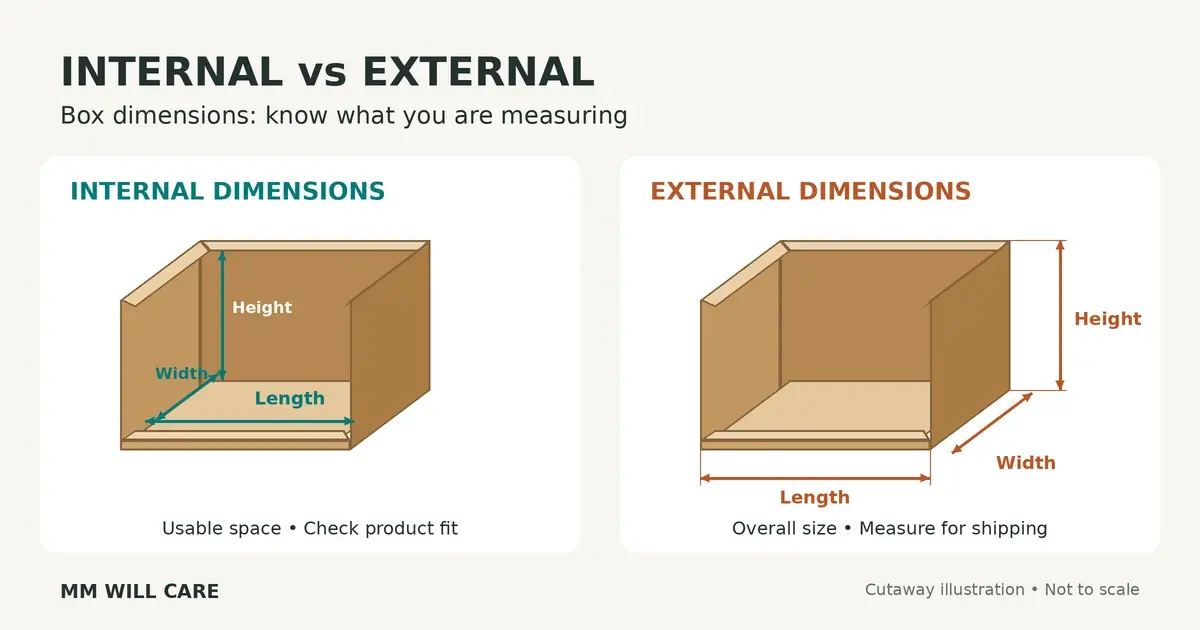
When you buy corrugated boxes online, manufacturers list the dimensions as Length x Width x Height. Critically, these are almost always the Inside Dimensions (ID).
- Inside Dimensions tell you the actual usable space available for your product and cushioning.
- Outside Dimensions (OD) are larger because they include the thickness of the corrugated cardboard walls. Courier companies calculate shipping costs based on the Outside Dimensions.
Always match your product + cushioning measurements directly to the manufacturer's listed Inside Dimensions.
4. Optimize to Avoid Dimensional Weight (DIM) Charges
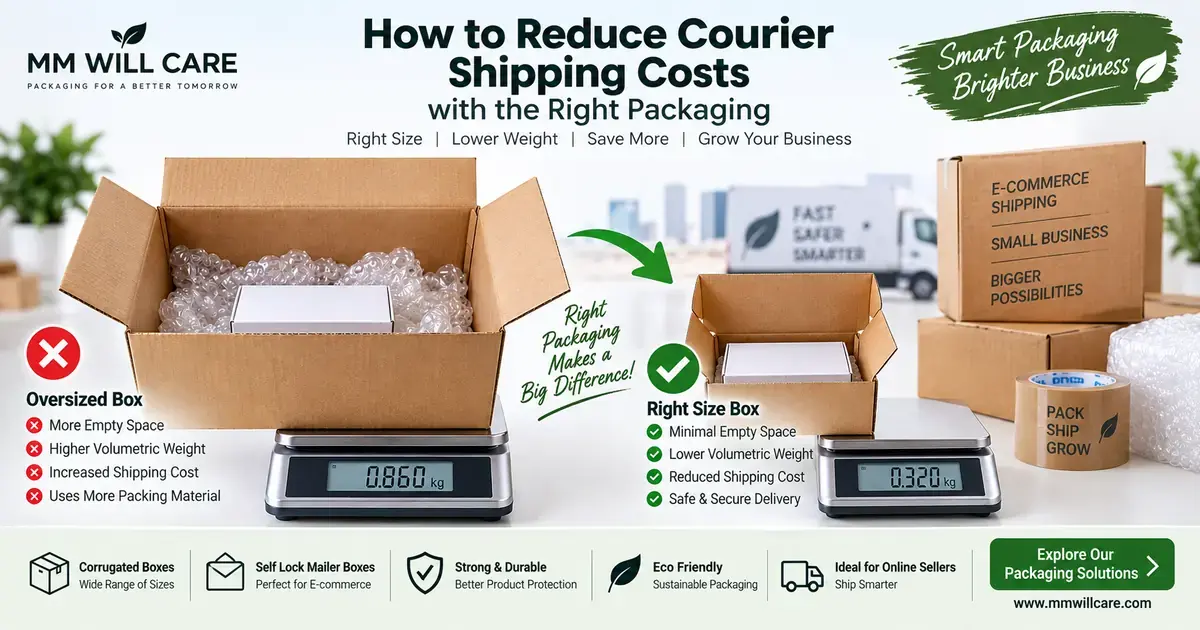
Courier services don’t just charge by how heavy a box is; they also charge by how much space it takes up in their delivery trucks. This is called Dimensional Weight (DIM) or Volumetric Weight.
\(\text{Dimensional\ Weight}=\frac{\text{Length}\times \text{Width}\times \text{Height\ (in\ cm)}}{\text{Courier\ Courier\ Factor\ (e.g.,\ 5000)}}\)
If your box is unnecessarily large, the courier company will bill you for a higher weight class, eating into your profit margins. To prevent this, choose specialized, compact boxes like Auto-Lock Mailer Boxes for small goods, rather than placing small items into oversized, standard shipping cartons.
5. Match the Box Style to Your Product Size
Different product sizes and categories thrive in different box shapes:
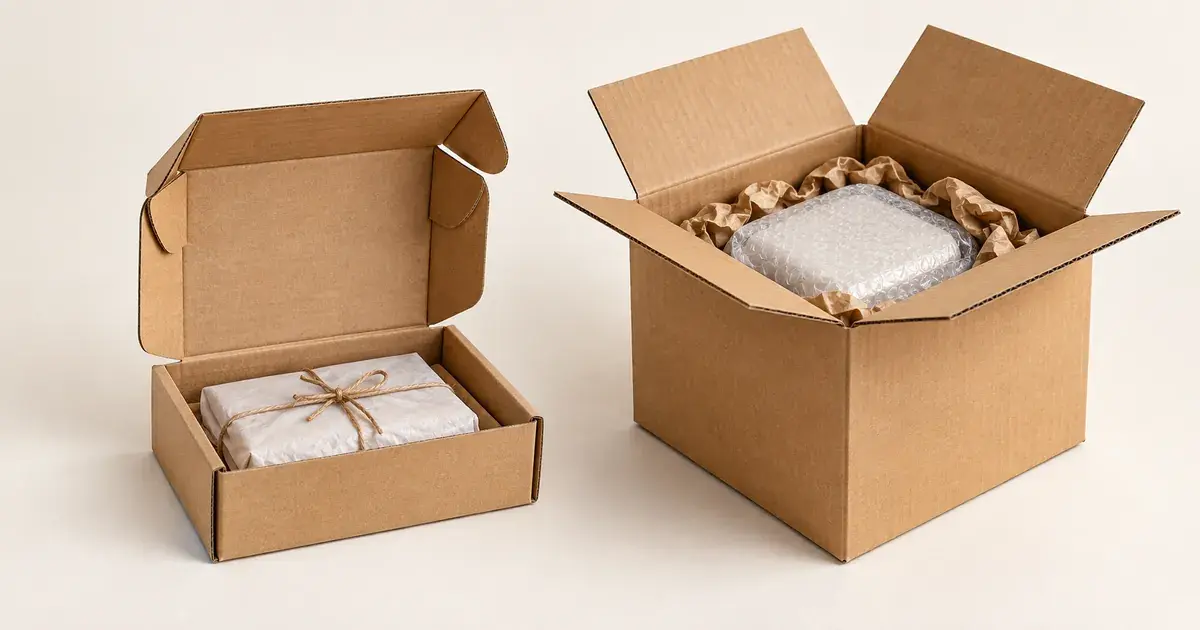
- Self-Lock / Mailer Boxes: Best for small, lightweight, or premium items (e.g., cosmetics, jewelry, small electronics). They lay flat, assemble easily without tape, and provide a sleek unboxing experience.
- Regular Slotted Cartons (RSC): The traditional shipping box where the flaps meet in the center. Best for medium to large, heavy items (e.g., appliances, bulk goods) that require heavy-duty packing tape to seal.
6. Consider the Product’s Fragility
Fragile products require more than just the correct box size.
Items such as glass bottles, electronics, cosmetics, ceramics, and decorative products should be individually wrapped and kept away from the box walls. Use suitable cushioning around all sides and fill empty spaces so the product cannot move.
For fragile items, select a box that provides enough room for protection without allowing excessive movement.
7. Check the Product’s Shape
Not all products are rectangular. Round, cylindrical, tall, or irregularly shaped products require special attention.
Measure the maximum length, width, and height of the product. Do not measure only the narrowest points. Projections such as handles, caps, switches, and corners must be included in the final measurements.
If the product has an unusual shape, corrugated inserts or dividers can help keep it secure.
8. Test the Box Before Bulk Ordering
Before ordering a large quantity of corrugated boxes, pack a sample shipment and check:
- Whether the product fits comfortably
- Whether sufficient cushioning can be added
- Whether the box closes without pressure
- Whether the product moves when the box is shaken gently
- Whether the box remains strong after sealing
- Whether the final dimensions are economical for courier shipping
A sample test can prevent incorrect bulk purchases and reduce packing problems.
Common Box-Selection Mistakes
Avoid these common mistakes when selecting courier boxes:
- Choosing a box with exactly the same dimensions as the product
- Ignoring the space required for protective packaging
- Using an oversized box for a small product
- Confusing internal and external dimensions
- Selecting weak corrugated material for heavy products
- Forgetting to calculate volumetric weight
- Leaving empty spaces inside the package
- Buying in bulk without testing a sample box
Quick Example
Suppose you want to ship a cosmetic bottle with the following measurements:
- Product size: 4 × 3 × 6 inches
- Bubble-wrap allowance: approximately 0.5 inch on each side
After wrapping, the product may require an internal space of approximately 5 × 4 × 7 inches. You should therefore select a box with internal dimensions close to this size, provided the box has sufficient strength and the wrapped product does not move inside it.
Final Checklist
Before selecting your corrugated courier box, confirm:
- The product’s packed length, width, and height
- The amount of cushioning required
- Whether the listed box size is internal or external
- The product’s actual weight
- The required corrugated strength
- The shipment’s estimated volumetric weight
- The most suitable box style
- The final fit through a sample-packing test
Conclusion
The right corrugated box should protect the product, minimize empty space, withstand courier handling, and keep shipping charges under control. Measure the fully prepared product carefully, add only the necessary cushioning allowance, and select a box with suitable strength.
MM WILL CARE offers corrugated shipping boxes, self-locking mailer boxes, and packaging materials in different sizes for e-commerce, courier, gift, jewellery, cosmetic, and general product packaging. Choosing the correct size can help your business achieve safer deliveries, better presentation, and more efficient packing.